

In a massive show of strength, reassurance to NATO allies and a warning to the traditional punchbag – Russia, six B-52H Stratofortress bombers on August 28th took part in mission Allied Sky and flew over 30 NATO nations. However, things did not go as well as planned for the escorting F-35 jets.
US Demonstrates Technology To Launch A ‘Drone From A Drone’ & Recover It Back Mid-Air
Mission Allied Sky was managed by two teams: four B-52s with the 5th Bomb Wing, from Minot Air Force Base, North Dakota, deployed to RAF Fairford, UK, were required to cover European part of the mission flying single-ship sorties; two B-52s, also belonging to the 5th Bomb Wing at Minot Air Force Base, flew as a two-ship formation over Canada and the US.
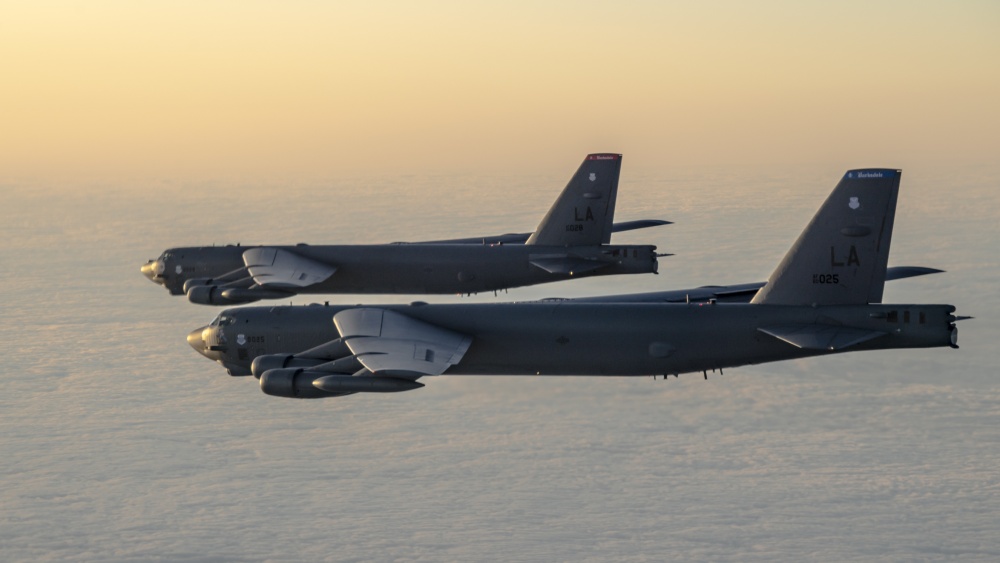
US Bombers during Mission Allied Sky. Via Twitter
The F-35s of the Royal Netherlands Air Force were tasked to escort one of the B-52 bombers. The Dutch Air Force (Koninklijke Luchtmacht) had announced the participation of its F-35a Lightning II fighters but the mission was abandoned as F-35s could not ‘strangely’ operate in bad weather.
Indeed, as Sidney Plankman, a Dutch MoD spokesperson confirmed to the Algemeen Dagblad media outlet in an article published on September 19, 2020, the intention was that the brand new F-35s from Leeuwarden Air Base would escort the B-52s. However, “there was a great risk of lightning that day. Therefore we have decided not to do it.”
Prior the Algemeen Dagblad article, the Dutch MoD issued a news release to explain that the Dutch F-35s are tentatively not flying due inclement weather and thunderstorms.
“Damaged pipes have been found on F-35A fighters. These are pipes from the On-Board Inert Gas Generation System (OBIGGS) in a fuel tank. All countries with F-35As were advised to avoid flights near storm cells and to protect the aircraft on the ground by a shelter or lightning rod,” says the Dutch MoD statement.

“The OBIGGS ensures that the risk of explosion of fuel vapours in the event of, for example, a lightning strike is reduced to a minimum. The damaged pipes can make the fuel tanks less well protected. After damaged pipes were found on 4 (non-Dutch) aircraft, further inspections followed. More damaged pipes were found, including at Dutch F-35As. The cause of the problem is still under investigation.”
Morgen nemen wij met F-35’s deel aan de oefening Operation Allied Sky. Operation Allied Sky is een gezamenlijke oefening met @NATO bondgenoten en wordt georganiseerd door @US_Stratcom & @US_EUCOM #StrongerTogether Meer info: https://t.co/giUg65cTqt pic.twitter.com/Rp5QScgxfq
— Koninklijke Luchtmacht (@Kon_Luchtmacht) August 27, 2020
The F-35s have been plagued with these issues for several years now. The deficiencies with the system that is supposed to pump nitrogen-enriched air into the fuel tanks to inert them were first uncovered during tests in 2009. The testing exposed F-35s deficiencies and concluded that the mighty and stealthy jets can explode if struck by lightning.
Read the original article on The Aviationist. Penned & Edited By Contributor – Tim Edwards